

South Africa’s extreme dependency on imported oil, which has been unmasked by recent events in the Middle East and closure of the Strait of Hormuz, exposes the country to price volatility and supply interruptions.
The war between the US and Iran, which has also affected Iran’s neighbouring countries, has disrupted global oil supply and sent prices skyrocketing.
On 14 September, the Brent crude price stood at $105.63 per barrel, up $67.63 a year before.
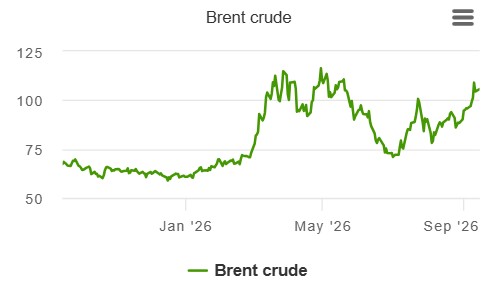
Source: Moneyweb
In August, petrol prices in South Africa were between 19% and 28% higher than a year prior – and diesel prices have increased even more.
According to the BloombergNEF (formerly Bloomberg New Energy Finance) South Africa Transition Factbook 2026 that was released a week ago, South Africa stands out for its reliance on imported oil products.
Imports significantly exceed exports, resulting in a negative trade balance equivalent to nearly 5% of the country’s GDP. Other African countries with similarly high levels of dependence are Nigeria, Morocco and Ghana.
The South African Reserve Bank recently said SA’s refining capacity has halved over the past decade.
Imported refined products now supply more than half of domestic fuel demand, raising exposure to global price shocks and shipping disruptions.
This dependence also increases South Africa’s vulnerability to rand volatility.
Government is trying to manage this by, among others, subsidising retail fuel prices initially, taking measures to increase strategic stocks and planning to rebuild some refining capacity in Durban through its Central Energy Fund.
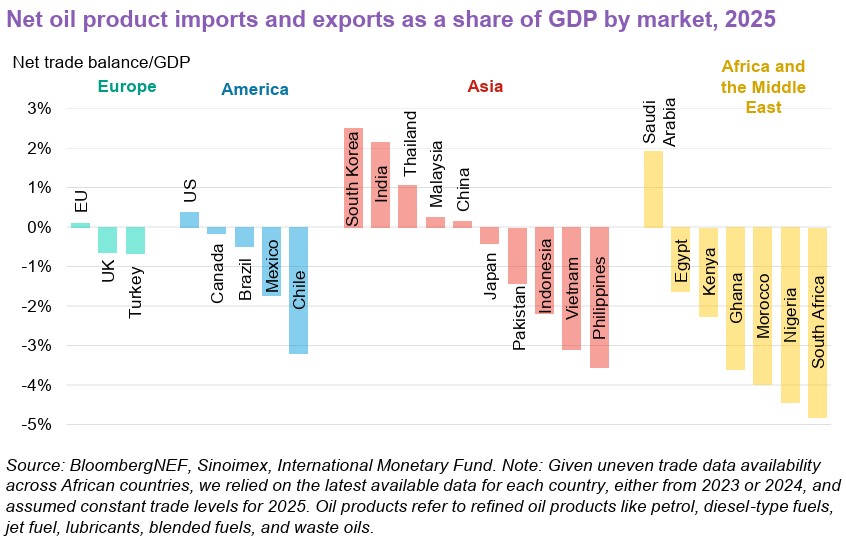
Source: BloombergNEF South Africa Transition Factbook 2026
The current crisis could, however, accelerate growing demand for clean tech, shifting imports from oil products to low-carbon technologies such as solar, wind, batteries and electric vehicles, according to the BloombergNEF report.
South Africa’s transition to a greener and more competitive energy market reduces its dependence on imported fossil fuels over the long term, the report states.
Fossil fuel imports accounted for 4.5% of South Africa’s GDP in 2024, and could fall to 4.3% in 2030, 2.8% in 2040 and 1.6% by 2050.
This is assuming no further policy support for the energy transition beyond existing measures and is largely driven by declining imports of oil products and internal combustion engine (ICE) vehicles.
Faster option
In a maximum-effort pathway towards net zero across power, transport, industry and buildings sectors by 2050 under defined sectoral carbon budgets, BloombergNEF says fossil fuel imports could decline more rapidly – to 1.8% in 2040 and 0.6% by 2050 – as electrification accelerates and demand for imported fossil fuels falls.
“Lower fossil fuel imports improve South Africa’s economic resilience. Reduced dependence on imported fuels lowers exposure to global energy price volatility and supply disruptions, while supporting the trade balance by reducing the country’s fossil fuel import bill over time.”
The Transition Factbook 2026 shows that South Africa is already the biggest importer of clean energy products in sub-Saharan Africa.
“Solar demand in South Africa and the rest of sub-Saharan Africa was fuelled by the closure of the Strait of Hormuz, which raised regional concerns around surging costs and energy security,” the report states.
“Battery demand is picking up for similar reasons, as homes and businesses installing small-scale solar systems are adding batteries to cut their reliance on unreliable grid power as much as possible.
“Wind plays a much smaller role: outside of South Africa; it is difficult to secure the typical scale of financing required for wind projects. It is also logistically difficult to develop wind projects due to limited port and road infrastructure in several markets.”
Nevertheless, investment in renewable energy fell by 41% from $8.6 billion in 2024, according to BloombergNEF.
Read: Dangote’s fortune set to jump $23bn on refinery IPO
“Fewer utility-scale projects reached financial close in 2025, with utility solar down 57% to $1.4 billion, and onshore wind dropping 30% to $2.1 billion.
“Small-scale solar broke the trend, growing 35% to $1.8 billion and softening the overall drop.
“Despite the decline in South Africa, investment across SSA [sub-Saharan Africa] rose 5.5% from 2024, driven by small-scale solar booms in markets like Nigeria and Kenya.”
It adds: “In Nigeria, over 99% of investment went to small-scale solar, as capital costs and a lack of bankable offtakers limited utility-scale deals.”
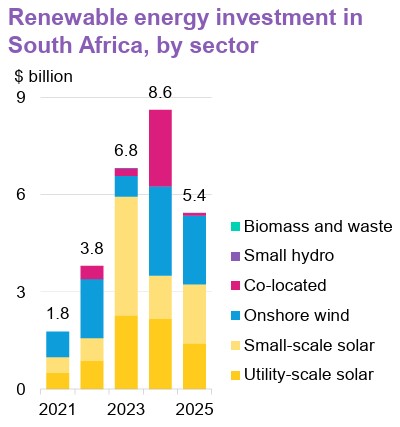
Source: BloombergNEF South Africa Transition Factbook 2026
BloombergNEF emphasises that the current energy market reforms in South Africa will help to promote private-sector investment, renewables deployment and electricity system resilience.
Eskom is being unbundled and a competitive wholesale market is being developed.
“Globally, wind and solar comprised an average 18% of generating capacity in 2024 where a wholesale market was operational compared with 4% for vertically integrated utilities.
“However, power market reform also raises challenges: liberalisation in the European Union took nearly three decades.”
Taking lessons from European market reforms, BloombergNEF says strong political commitment to reform, clear implementation timelines and independent regulators are key to overcome resistance from incumbents and concentrated markets.
It warns against insufficient legal or accounting separation and says vertically integrated utilities continue to discriminate against competitors – thus eventually ownership or operational unbundling is required.
A common risk, which is already a reality in South Africa, is that generation growth outstrips grid expansion. The report says grid reform must accompany market liberalisation to avoid bottlenecks downstream.
BloombergNEF points out that governments had to offer revenue-certainty mechanisms and policies to promote power purchase agreements in the EU. – moneyweb.co.za
